


Diamond Price Trends: What Actually Moves the Price
There is no single "diamond price" — a stone's price depends on its exact combination of carat, cut, colour, clarity and certification, and that combination shifts constantly with supply. Lab-grown diamond prices have fallen sharply as manufacturing scaled, widening the gap to natural. Compare live, certified inventory rather than trusting a fixed price list.
Search "diamond price" and you will find plenty of round numbers presented as fact. In practice there is no single diamond price — two stones of the same carat weight can differ in price by 50% or more depending on cut, colour, clarity and certification, and the going rate for any given combination shifts with supply. This guide explains what actually moves diamond prices, so a quoted number means something rather than just sounding official.
Carat weight is not the price driver on its own
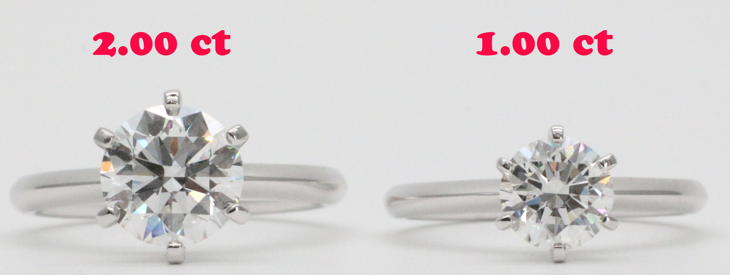
Price per carat rises faster than carat weight itself, because larger rough stones are rarer and yield fewer finished diamonds. That is why a 2-carat diamond typically costs more than double a 1-carat diamond of the same quality, and why prices tend to jump noticeably at psychological carat thresholds (0.50, 0.70, 0.90, 1.00) as cutters aim just above the mark. See our 1-carat diamond guide and 2-carat diamond guide for the current spread at those weights.
Cut, colour and clarity move the price more than most buyers expect
Within one carat band, three grades typically swing the price the most:
- Cut — the single biggest driver of visible sparkle, and the grade most buyers under-weight. An Excellent-cut stone can look larger and brighter than a poorly cut stone of higher carat weight.
- Colour — near-colourless grades (G–H) are the sweet spot for value once the diamond is set, since mounting and lighting hide most of the difference visible loose.
- Clarity — VS1–VS2 and SI1 are eye-clean at most carat weights; Flawless and Internally Flawless carry a large premium for a difference invisible without a loupe.
Two diamonds at the same carat weight can be priced very differently once these three are factored in — which is why comparing "price per carat" across listings only makes sense when the full 4Cs match.
Natural diamond prices: controlled supply, rarity-driven at the top end
Natural diamond supply is concentrated among a small number of major producers, and larger, higher-quality rough is genuinely scarce — which keeps prices for large, high-grade natural stones structurally firm over time. At common carat and quality combinations, prices move with broader jewellery demand and are more exposed to competition from lab-grown alternatives than they were a decade ago.
Lab-grown diamond prices: a steep, ongoing decline
Lab-grown diamond prices have fallen substantially and repeatedly since CVD and HPHT production scaled up worldwide, and that decline has continued rather than levelling off. The practical effect: the price gap between a natural and a lab-grown diamond of identical 4Cs has widened significantly, and it is reasonable to expect further softening in lab-grown pricing as production capacity keeps growing. Our lab-grown diamond guide shows the current gap using live inventory rather than a fixed percentage.
How to actually check today's price
Because all of the above shifts continuously, the only reliable way to know a real price is to compare live, certified inventory on matching specifications rather than trust a published price list:
- Fix the 4Cs you care about (or a tight range) and compare only within that range.
- Use our live GIA and IGI certified inventory, filterable by shape, carat, cut, colour and clarity.
- Compare a natural stone against a lab-grown stone of the same specification side by side before deciding.
- Confirm the certificate is from GIA or IGI — grading is not standardised across labs, so an uncertified or lesser-known lab's grade is not directly comparable.
Frequently asked questions
Are diamond prices going to keep falling?
Lab-grown diamond prices have shown a sustained downward trend as production scales, and that trend looks set to continue for the foreseeable future. Natural diamond prices for large, high-quality stones tend to be more resilient because that supply is genuinely limited, while prices for common, smaller combinations move more with general demand and lab-grown competition.
Why do two "1-carat" diamonds have such different prices?
Carat weight is only one of four grading factors. A 1-carat diamond can range from a modest budget stone to a premium one depending on its cut, colour and clarity grade — see our 1-carat diamond price guide for the live spread.
Is a lower price always a red flag?
Not necessarily — it often just reflects a lower colour or clarity grade, or a lab-grown rather than natural stone, both of which are legitimate ways to buy more visible diamond for the same budget. It becomes a red flag only when there is no GIA or IGI certificate to verify the grade being sold.
Related guides


