GIA Teaches You the 4Cs - How to Choose a Diamond

Types of Diamond Clarity Characteristics
Diamonds form under extreme heat and pressure, and almost every diamond has internal and external characteristics — these are known as clarity characteristics. They help gemologists distinguish natural diamonds from synthetics, simulants and other gemstones.
Clarity characteristics are divided into two categories: Inclusions (internal, shown in red) and Blemishes (external, shown in green). A GIA grading report provides a plotting diagram that uses symbols to describe the type, location and size of each characteristic.


Inclusions
Common types of diamond inclusions:
Crystal
Crystal
A mineral crystal contained within the diamond.
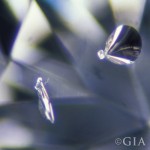
Feather
Feather
A common term in gemology for a white, feather-like inclusion inside the diamond.
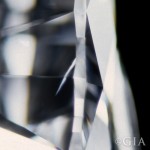
Pinpoint
Pinpoint
A very tiny crystal, visible as a single dot.
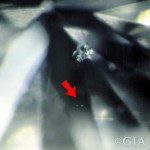
Cloud
Cloud
A cluster of pinpoints concentrated inside the diamond; together they can give a hazy appearance.
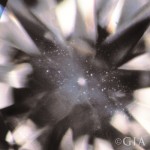
Twinning Wisp
Twinning Wisp
A series of pinpoints, clouds or crystals forming an extensive wispy streak.
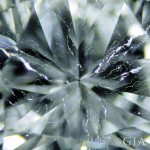
Needle
Needle
A long, thin crystal inside the diamond that resembles a fine rod under 10× magnification.

Knot
Knot
A white or transparent diamond crystal that extends to the surface.
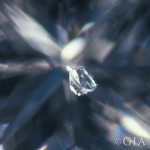
Grain Center
Grain Center
A small, concentrated area of crystal distortion; may appear white, black, or have a linear or pinpoint-like appearance.
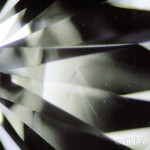
Internal Graining
Internal Graining
Under 10× magnification, white, coloured or colourless lines, angles or curves inside the diamond that affect transparency; may result from irregular crystal growth.
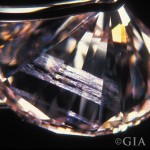
Laser Drill Hole
Laser Drill Hole
A channel reaching the diamond's surface created by laser drilling to bleach dark inclusions and reduce their visibility.
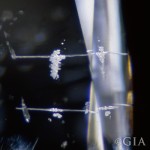
Blemishes
Common types of diamond blemishes:
Indented Natural
Indented Natural
A portion of the original rough-diamond surface that dips below the polished surface.
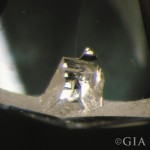
Cavity
Cavity
An angular opening on the surface, created when a feather breaks or an included crystal is lost during polishing.
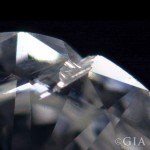
Chip
Chip
A small, shallow opening on the surface, typically at the girdle, facet junction or culet due to surface wear.
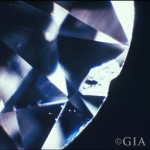
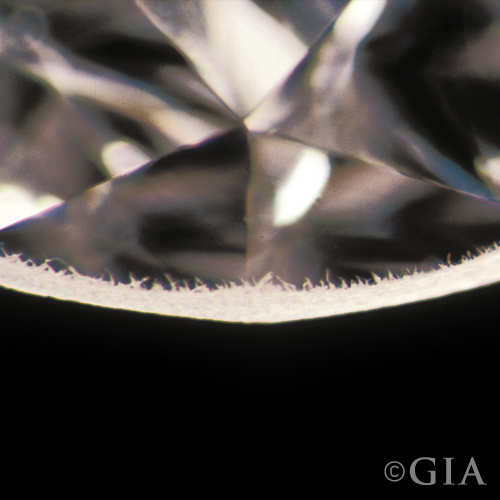
Bearded Girdle
Bearded Girdle
Tiny feather-like inclusions extending from the girdle inward; usually caused during the polishing process.